
Commercial landscaping was once viewed primarily as a maintenance service. Property owners hired contractors to mow lawns, trim hedges, remove weeds, and keep outdoor areas presentable. Although those responsibilities remain…
Read More...





Overnight Success is one of the most repeated phrases in business, but it is also one of the most misleading. From the outside, a company can look like it appeared suddenly, captured attention, gained customers, raised capital, and became the business everyone is talking about. Behind the scenes, that same company may have spent years testing ideas, missing targets, changing direction, dealing with cash flow pressure, losing sleep, and slowly learning what the market actually wanted.
The myth of Overnight Success is attractive because it makes success look clean and simple. It allows people to believe that one great idea, one viral campaign, one investor meeting, or one lucky break can change everything. In reality, most businesses are built through repetition, patience, and a long list of unglamorous decisions. The public sees the launch, the press coverage, the funding announcement, or the rapid growth. What it usually does not see is the decade of preparation that made the moment possible.
For entrepreneurs, business owners, and people thinking about starting a business, this matters. If success is viewed as something that should happen quickly, frustration can arrive too early. A slow first year may feel like failure. A difficult funding environment may feel like a sign to quit. A period of low visibility may feel like proof that the business is not working. However, many strong companies take years before the market starts to notice them.
When a business starts gaining attention, people often treat that moment as the beginning of the story. A company gets featured in a publication, lands a major client, opens a new location, or becomes a recognized name in its category. To outsiders, it may seem like the business came out of nowhere. To the founders and early team members, that moment is usually the result of years of trial and refinement.
Companies like Shopify did not become meaningful business platforms because one moment went right. Their growth came from understanding a market need, building tools that merchants could use, improving those tools over time, and staying focused on a clear customer problem. The visible success was built on product development, merchant feedback, technical improvement, and years of market education.
The same can be said for many businesses that seem simple from the outside. A restaurant group, a software company, a consulting firm, a logistics provider, or a niche manufacturing company may appear to scale quickly after a certain point. What is less obvious is that the owner may have spent years building supplier relationships, learning pricing discipline, refining hiring practices, studying customer behavior, and absorbing painful lessons from earlier mistakes.
The public moment is often just the point where preparation becomes visible. The work started much earlier. That is why entrepreneurs should be careful about comparing their private struggle to someone else’s public breakthrough. The timeline they are seeing is incomplete.
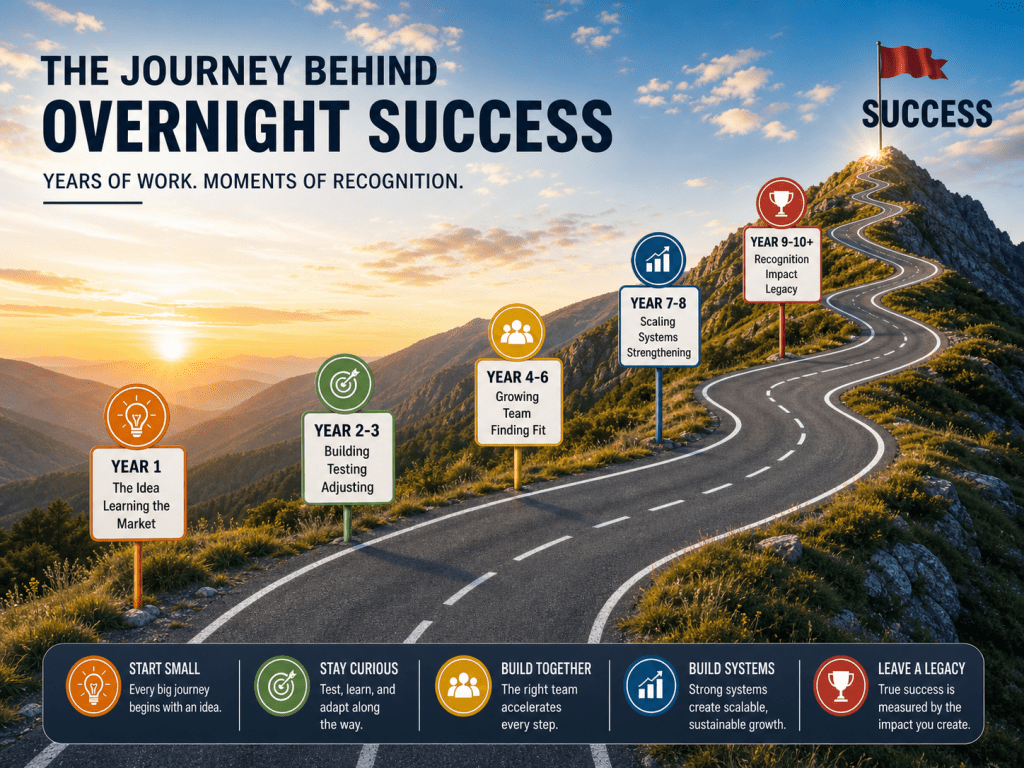
The phrase “Overnight Success Takes About Ten Years” does not mean every successful company needs exactly a decade. Some businesses grow faster. Others take longer. The phrase is useful because it reminds business owners that meaningful success usually requires time. It takes time to understand customers. It takes time to build trust. It takes time to improve operations. It takes time to become known for something specific.
Many entrepreneurs underestimate the learning curve. They may start with strong energy, a good idea, and a belief that hard work will produce quick results. Hard work matters, but it does not always create immediate traction. Markets have their own timing. Customers may not be ready. Capital may be harder to access than expected. Competitors may already have strong relationships. Advertising may cost more than planned. Technology may take longer to build. Hiring may be more complicated than anticipated.
A longer timeline does not mean the business is failing. In many cases, the first several years are where the foundation gets built. A business owner learns which customers are profitable, which services create problems, which employees fit the culture, which marketing channels produce real leads, and which expenses quietly drain the company. These lessons rarely arrive all at once. They come through experience.
That is why patience should not be confused with passivity. Waiting ten years without improving the business is not a strategy. The point is not to simply let time pass. The point is to use time well. A company that learns every year, improves its systems, strengthens its brand, and becomes more disciplined can look very different after five or ten years than it did in its early stages.
The current interest rate environment has made the path to business success feel more demanding for many owners. The Federal Reserve held the federal funds target range at 3.50 percent to 3.75 percent on April 29, 2026, while noting that it would continue reviewing incoming data, the economic outlook, and risk conditions. That matters because borrowing costs affect expansion plans, commercial real estate decisions, equipment purchases, working capital lines, and investor expectations. :contentReference[oaicite:0]{index=0}
When money is inexpensive, growth can sometimes hide weak business discipline. Companies may borrow more easily, hire faster, sign longer leases, spend aggressively on marketing, or invest in technology before the revenue model is fully proven. When rates remain elevated or uncertain, the margin for error becomes smaller. Monthly debt service can weigh on cash flow. Investors may become more selective. Banks may ask harder questions. Business owners may have to justify every major expense with greater precision.
This does not mean entrepreneurs should stop building. It means the idea of Overnight Success becomes even more unrealistic. A stronger rate environment rewards companies that are patient, careful, and operationally sound. A business that understands its numbers, protects cash, manages debt responsibly, and knows its customer acquisition cost is better positioned than one built only on enthusiasm.
For instance, a business owner who wants to open a second location may need to think differently than they would have several years ago. The question is not only whether the first location is popular. The owner also has to consider rent, financing costs, staffing, equipment, inventory, insurance, and the amount of time it may take before the second location becomes profitable. Growth is still possible, but reckless expansion can create problems that momentum alone cannot solve.
The work that produces success is often boring to watch. It is answering customer emails quickly. It is updating the website. It is improving the sales script. It is reviewing financial statements. It is calling vendors. It is fixing internal processes. It is training employees. It is following up with prospects who are not ready to buy yet. It is learning why customers say no.
These activities rarely produce applause, but they create the conditions for growth. A company like Toast built its position in the restaurant technology space by serving a specific industry with tools that addressed real operational needs. Restaurant technology is not just about having software. It is about understanding payment flows, kitchen operations, staff turnover, menu changes, reporting, and the daily pressure restaurant owners face. That kind of market understanding takes time.
The same principle applies to service businesses. A consulting firm may spend years developing credibility before referrals become steady. A construction company may need multiple completed projects before larger clients feel comfortable awarding bigger contracts. A digital marketing agency may need case studies, client retention, and proven results before it can move beyond price based competition. The visible growth often arrives after the business has already done years of quiet work.
Many entrepreneurs want the breakthrough but resist the repetition that creates it. They want the large contract but do not want to build the proposal system. They want investor interest but do not want to clean up financial records. They want better employees but do not want to define roles clearly. They want strong customer loyalty but do not want to improve the customer experience. The breakthrough usually comes after the business becomes more disciplined in areas that do not look exciting from the outside.
Trust is one of the most valuable assets a business can build, but it cannot be rushed. A company may be able to create a logo, website, social media presence, and marketing campaign quickly. Trust takes longer. Customers need repeated proof that the business can deliver. Employees need to see that leadership is consistent. Vendors need to know the company pays on time. Lenders and investors need confidence that management understands risk.
Companies like HubSpot became known not only because they sold software, but because they invested heavily in education, content, and customer understanding. Their brand was connected to a broader conversation about inbound marketing and sales. That kind of positioning does not happen overnight. It comes from consistently showing the market what the company believes, who it serves, and how it solves problems.
Smaller businesses can use the same principle. A local business owner may not need national recognition, but they do need a reputation. A regional service provider may not need millions of followers, but they do need customers who trust them enough to refer others. A startup may not need immediate fame, but it does need credibility with early users. Trust compounds slowly, then becomes powerful.
That compounding effect is why a business can seem to grow suddenly after years of steady work. Referrals increase. Repeat customers return. Search rankings improve. Vendor relationships become stronger. Employees become more capable. The business owner becomes more confident and more selective. What looks sudden from the outside may actually be the result of trust that was built one interaction at a time.
The Overnight Success narrative usually removes failure from the story. That makes success look cleaner than it really is. Many successful business owners have launched ideas that did not work, hired the wrong people, spent money on poor marketing, priced services incorrectly, trusted the wrong vendor, or expanded too soon. These mistakes can be expensive, but they can also become part of the education that helps the business survive later.
A company like Airbnb faced early skepticism because the concept was unfamiliar to many people. The business had to overcome trust issues, supply challenges, regulatory questions, and market resistance. The company became widely known later, but its path involved persistence through problems that could have stopped the business before it became a household name.
Entrepreneurs should not romanticize failure, but they should understand its role. Failure is not automatically valuable. A mistake becomes valuable only when the owner studies it honestly and changes behavior. Losing money on a bad campaign is not helpful if the company repeats the same campaign. Hiring poorly is not useful if the business never improves its recruiting process. A failed partnership does not teach much unless the owner learns how to evaluate alignment, expectations, and written agreements more carefully.
The businesses that last are not the ones that avoid every mistake. They are the ones that get better after mistakes. That ability to adjust is often what separates a serious business from a short lived idea.
Money has a way of revealing whether a business is truly strong. Revenue growth can be exciting, but it does not automatically mean the company is healthy. A business can grow sales and still struggle if margins are weak, collections are slow, debt is too high, or overhead grows faster than profits.
In a higher cost borrowing environment, capital discipline becomes even more important. Entrepreneurs need to understand their numbers before making major commitments. That includes gross margin, net profit, customer acquisition cost, cash conversion cycle, monthly fixed expenses, debt service, and break even points. These numbers may not sound inspiring, but they determine whether the business has staying power.
Tools from companies like QuickBooks, Xero, and Square can help owners track financial activity, payments, and business performance. The tools themselves do not create discipline, but they can support better decision making when owners pay attention to the data.
A business owner chasing Overnight Success may focus too heavily on attention and not enough on durability. Attention can bring leads, but it can also bring pressure. If the operations are weak, too much growth can damage the customer experience. If the finances are fragile, a short cash gap can become a crisis. If leadership is unprepared, a rapid increase in demand can expose every internal weakness.
There is no denying that timing plays a role in business success. A company can benefit from a market shift, new technology, consumer trend, or economic change. However, timing helps most when the business is prepared to act. Opportunity is easier to capture when the company already has a strong product, a clear message, capable people, and financial stability.
Consider Canva. Its rise connected to a clear need in the market: simpler design tools for non designers, small businesses, educators, marketers, and teams. The timing was favorable as digital content creation expanded, but timing alone was not enough. The company had to build a product that people could actually use and continue improving it as demand grew.
Many business owners wait for the perfect moment. The better approach is to become ready before the moment arrives. That means creating systems before growth hits. It means refining the offer before larger customers appear. It means building financial controls before more money moves through the business. It means developing leadership skills before the team grows larger.
When preparation meets timing, the result can look like Overnight Success. The reality is more practical. The business was ready when the market finally opened a door.
Businesses often stop growing because the founder stops growing. Early stage entrepreneurship rewards energy, urgency, and willingness to do everything. As the business matures, the owner needs different skills. They need to manage people, read financial reports, negotiate better agreements, delegate responsibility, set priorities, and make decisions with incomplete information.
A founder who is excellent at selling may struggle with operations. A founder who is creative may avoid financial discipline. A founder who is technical may underestimate branding and customer experience. A founder who is comfortable doing everything may become the bottleneck that prevents growth. The ten year journey is often as much about the owner’s development as it is about the company’s development.
Businesses like Atlassian grew by serving teams that needed better collaboration and project management tools. That kind of growth requires more than a useful product. It requires leadership systems, hiring discipline, customer support, product direction, and the ability to scale without losing clarity. The founder’s role changes as the company changes.
For smaller companies, the same lesson applies. The owner who starts the business may need to become a stronger manager, planner, negotiator, communicator, or financial thinker. Growth demands personal adjustment. If the owner refuses to change, the business may remain trapped at the level that matches the owner’s current habits.
Fast growth gets attention, but slow growth can create a stronger company. A slower build gives business owners time to understand customers, correct mistakes, improve margins, refine hiring, and strengthen operations. It allows the company to grow into its reputation rather than being crushed by it.
Slow growth also gives owners time to decide what kind of business they actually want. Not every entrepreneur wants outside investors. Not every business needs national expansion. Not every company should chase rapid scale. Some owners want a profitable regional business. Others want a lifestyle business with strong cash flow. Some want to build an acquisition target. Others want to create a company that can operate without them someday.
The Overnight Success myth pushes everyone toward speed. Real business strategy asks a better question: what kind of success is worth building? A company that grows carefully, serves customers well, protects its finances, and builds a durable reputation may be far more valuable than one that gets attention quickly but cannot sustain itself.
Overnight Success is usually not overnight at all. It is the visible result of years of preparation, discipline, mistakes, adjustments, and persistence. For entrepreneurs and business owners, that should be encouraging rather than discouraging. A slow start does not mean the dream is over. A difficult economy does not mean opportunity has disappeared. Higher interest rates, tighter capital, and cautious customers may make the journey harder, but they can also reward businesses that are thoughtful, prepared, and financially disciplined. The companies that last are usually not built on one lucky moment. They are built through steady decisions that compound over time until the outside world finally notices.