
Commercial landscaping was once viewed primarily as a maintenance service. Property owners hired contractors to mow lawns, trim hedges, remove weeds, and keep outdoor areas presentable. Although those responsibilities remain…
Read More...





Vacant lots are often treated like unfinished business. They sit behind fences, collect weeds, attract code issues, and quietly cost money through taxes, insurance, maintenance, and liability exposure. Many property owners look at an empty parcel and see a future building, but until that building happens, the lot may sit idle for months or even years. That waiting period can be expensive.
For entrepreneurs and business owners, vacant lots deserve a different look. A piece of land does not always need a permanent structure to generate revenue. Depending on zoning, location, access, traffic flow, utilities, neighborhood demand, and local rules, vacant lots can be repositioned into practical business assets. Some uses are simple, such as parking or storage. Others are more active, such as food truck courts, seasonal retail, outdoor fitness space, contractor staging, or modular commercial uses.
The key is to stop viewing unused land only as a development project and start viewing it as an operating asset. A lot may not be ready for apartments, offices, or a retail building, but it may still be ready to produce income. For many owners, the better question is not what can eventually be built on the land, but what can the property do right now.
A vacant lot can feel less exciting than a building. There are no tenants, no interior improvements, no storefront, no lobby, and no obvious monthly rent roll. Because of that, owners often place vacant parcels into a holding category. They wait for the right buyer, the right development partner, the right market conditions, or the right future plan.
The problem is that land still has carrying costs. Property taxes continue. Grass needs to be cut. Fencing may need repairs. Trash may need removal. Insurance may be needed. In some locations, code enforcement issues can become a recurring headache. Even when the property is owned free and clear, it may still create negative cash flow if it is not being used.
Entrepreneurs tend to think differently. Instead of asking only what can eventually be built here, they ask what can this property do right now. That question opens the door to smaller, faster, and more flexible revenue streams. The best answer may not be glamorous, but a basic use that brings in consistent income can change the economics of ownership.
Parking is one of the most common ways to monetize vacant lots, especially in areas near downtown districts, stadiums, airports, beaches, hospitals, universities, entertainment venues, construction zones, or dense commercial corridors. A lot that looks ordinary during the week may become valuable during events, weekends, or seasonal peaks.
The attraction of parking is that it can be relatively simple compared with vertical development. Depending on local requirements, an owner may need grading, striping, signage, lighting, payment technology, fencing, security cameras, and proper permits. Still, that is often less complex than building a structure. In the right location, monthly parking, event parking, employee parking, valet overflow, or fleet parking can create steady income.
Technology has made parking easier to manage. Companies such as ParkMobile and Neighbor show how digital platforms can connect underused space with people who need parking or storage. A property owner does not necessarily need to build a large technology company to benefit from the same idea. The lesson is that convenience matters. If people can find the lot, understand the price, pay quickly, and feel comfortable leaving their vehicle, the lot becomes more marketable.
For business owners near congested areas, vacant lots can also become a solution to a local problem. Restaurants may need employee parking. Medical offices may need overflow parking. Contractors may need a place to park work vehicles overnight. A nearby hotel may need event parking during busy weekends. Instead of only marketing to the public, lot owners can approach nearby businesses and negotiate recurring arrangements.
Outdoor storage is another practical use for vacant lots. Contractors, landscapers, pool companies, roofing companies, moving companies, restoration companies, and small logistics operators often need secure space for trucks, trailers, equipment, materials, and containers. Many of these businesses do not need a polished office. They need safe, accessible, affordable space.
This can be a strong fit for lots located in industrial, commercial, or transitional areas where outdoor storage is allowed. A lot near highways, warehouses, construction growth, or trade heavy neighborhoods may have value as a contractor yard. Revenue can come from one tenant leasing the entire lot or from multiple smaller spaces rented to different users.
Companies such as PODS and U Haul have built major businesses around storage and moving needs, and their scale points to a broader truth: people and businesses consistently need flexible space. A vacant lot owner may not be running a national storage brand, but the local demand for equipment storage, trailer parking, and temporary staging can be very real.
The important point is to structure the use carefully. Owners should think about access hours, permitted items, environmental risks, hazardous materials restrictions, insurance requirements, security, drainage, lighting, and who is responsible for damage. A loose handshake arrangement can create problems. A proper written license or lease can help define what is allowed and what is not.
Vacant lots can also become platforms for small business activity. Food trucks, coffee carts, farmers markets, plant sales, holiday tree lots, pumpkin patches, craft markets, outdoor vintage sales, and mobile service businesses all need physical space. A well located lot can become a rotating stage for local entrepreneurs.
This approach works best when the lot has visibility, safe entry and exit points, pedestrian access, nearby demand, and a neighborhood that welcomes activity. A lot near offices may work for lunch vendors. A lot near nightlife may work for evening food trucks. A lot near residential neighborhoods may work for weekend markets. A lot near tourist corridors may work for seasonal retail.
The advantage is flexibility. Instead of committing to one long term tenant, the owner may rent spaces by the day, weekend, month, or season. That can produce income while also testing what type of use the market wants. If a weekend food truck event performs well, the owner may expand it. If a plant vendor draws traffic, the lot may support a recurring outdoor retail concept.
Companies such as PopUp Shops have helped normalize the idea that temporary retail can be a legitimate business strategy. The same thinking applies to land. Temporary does not have to mean low quality. With the right layout, signage, lighting, trash plan, restrooms, and vendor standards, a vacant lot can feel organized and professional.
Some vacant lots can support more than open air use. Modular structures, kiosks, shipping container units, small offices, mobile showrooms, and prefabricated buildings can create semi permanent business opportunities without the same timeline as conventional construction. This can be useful for owners who want income but are not ready to commit to a major buildout.
A small modular office might serve a used car operation, construction company, security office, equipment rental yard, nursery, or seasonal retail business. A shipping container setup might support a coffee concept, outdoor bar, micro retail space, or service counter, where local rules allow it. Companies such as Boxabl have drawn attention to modular building concepts, and while not every product is right for every lot, the broader trend shows continued interest in faster and more flexible space solutions.
The challenge is that temporary structures are still regulated. Owners should review zoning, building codes, fire safety rules, utility connections, ADA access, stormwater requirements, signage rules, and occupancy limits. A structure that feels temporary from a business standpoint may still be treated seriously by local authorities. That does not make the idea unworkable. It simply means planning matters.
When done correctly, modular uses can lift the lot from passive land to active business property. They can also help prove demand before a larger project is pursued. If a small coffee kiosk succeeds, that may support the case for a future retail building. If a contractor yard leases quickly, that may reveal stronger industrial demand than expected.
Some vacant lots can become event friendly properties. Outdoor movie nights, fitness classes, small concerts, car shows, art markets, food festivals, private gatherings, and brand activations may all need open space. Not every lot is suited for events, but the right parcel can produce strong short term revenue.
Event use is usually more management heavy than parking or storage. It may require permits, security, crowd control, portable restrooms, lighting, insurance certificates, noise compliance, vendor coordination, cleanup, and neighbor communication. Still, one well run event can sometimes produce more income than a month of passive use.
The best event lots usually have a combination of visibility, accessibility, nearby parking, safe circulation, and a setting that feels appealing. A vacant lot surrounded by active businesses may be easier to activate than a remote parcel with poor access. A lot near restaurants, breweries, galleries, entertainment districts, or waterfront areas may have more potential than a lot hidden behind industrial buildings.
There is also a branding benefit. A lot that was once seen as empty or neglected can become known as a gathering place. That can improve perception of the property and, in some cases, create future leasing or development interest. Local business owners may also see the property differently once they realize it can bring people together rather than simply sit unused.
Vacant lots can also be used for plant related businesses. Urban farms, plant nurseries, flower stands, community garden partnerships, composting programs, landscape supply staging, and greenhouse operations may all be possible depending on location and local rules. These uses can be especially attractive where the lot has sunlight, water access, and a neighborhood that values local food or landscaping.
A nursery or garden center does not always require a traditional building at the beginning. Shade structures, benches, gravel paths, irrigation, fencing, and simple checkout areas may be enough to start. A landscape company may use a lot to store mulch, plants, stone, or equipment while also selling certain products to local customers.
Green uses can also improve the look of an otherwise empty parcel. Instead of weeds and debris, the property becomes active, maintained, and visually appealing. For owners concerned about neighborhood perception, this can be valuable. It may also reduce illegal dumping or trespassing because the lot is visibly used and monitored.
Of course, owners must consider water use, soil condition, environmental history, runoff, pests, and permitted activities. If food is grown, the condition of the land matters even more. A phase one environmental review or soil testing may be appropriate for certain parcels, especially in former industrial areas.
Some vacant lots have value because of their location, not because of their surface use. A parcel with highway visibility may have billboard potential. A lot in a coverage gap may interest telecommunications companies. A property near traffic, retail, or multifamily housing may be considered for EV charging. A lot near distribution routes may have value for last mile logistics.
These opportunities can be attractive because they may involve long term leases and less daily management. A billboard lease, cell tower lease, or charging station agreement can create recurring income while using only part of the property. That leaves room for other compatible uses.
Companies such as ChargePoint and EVgo are part of the broader EV charging ecosystem, and their growth reflects how parking and energy infrastructure are becoming more connected. A vacant lot with the right electrical access, visibility, and traffic pattern may be more than empty land. It may be a future service point.
These deals can be complex. The owner should understand lease duration, exclusivity, access rights, utility responsibilities, revenue sharing, maintenance obligations, removal requirements, and how the installation affects future sale or development plans. A long term agreement can be beneficial, but it should not accidentally block a better future opportunity.
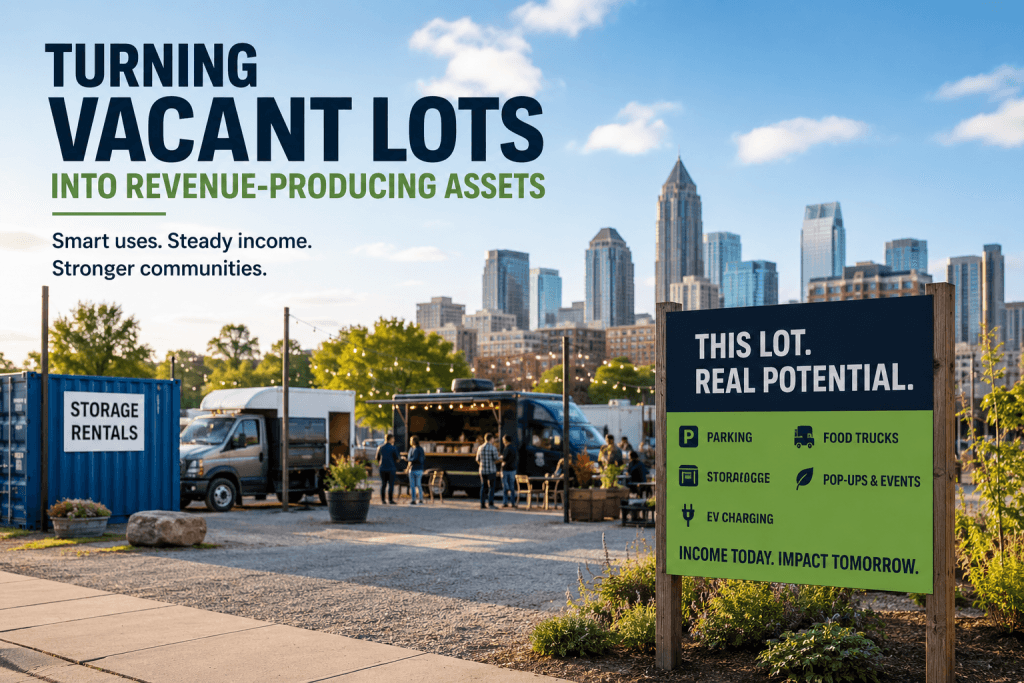
The best use for a vacant lot depends on practical details. A parcel near an airport may be ideal for parking or storage. A lot near nightlife may work for food trucks. A lot in an industrial corridor may be better as a contractor yard. A lot near residential growth may be useful for a nursery, weekend market, or small modular commercial concept.
Before choosing a direction, owners should look at zoning first. Zoning controls what can legally happen on the property. After that, they should study access, visibility, traffic counts, neighboring uses, safety, lighting, drainage, utilities, and the condition of the surface. A lot that floods after heavy rain may not work for vehicle storage without improvements. A lot with poor entry points may not work for events. A lot with no fencing may not be ready for equipment storage.
Owners should also think about the level of management they want. Parking may require payment systems and monitoring. Storage may require security and tenant controls. Events may require active coordination. Food truck lots may require vendor relationships and sanitation planning. A lower effort use may produce less income, but it may also create fewer headaches.
The goal is not always to chase the highest possible revenue. The better goal is to find the best balance between income, risk, effort, and future flexibility. A property owner who wants a simple monthly check may choose a single tenant storage use. An owner who enjoys promotion and community activity may prefer markets or events. An entrepreneur who wants to build a larger concept may use the lot as a testing ground for a future business.
Vacant lots can be especially appealing because they allow entrepreneurs to start small. A property owner can test one use, learn from demand, improve the lot, and then expand. A simple gravel parking area may later become a food truck court. A contractor yard may later support a small office. A weekend market may reveal that the neighborhood wants more retail. Each step can create data, relationships, and cash flow.
This approach also helps owners avoid making assumptions. Instead of guessing what the market wants, they can watch how people respond. Are nearby businesses asking for parking? Are contractors calling about storage? Are vendors interested in weekend space? Are residents showing up for outdoor events? The lot itself becomes a testing ground.
There is also a strategic benefit. Income from temporary uses can help cover taxes, maintenance, and holding costs while the owner works on a larger plan. That can reduce pressure to sell too early or accept a weak development deal. In some cases, the temporary use may become so profitable that the owner changes the future plan entirely.
Entrepreneurs should also remember that vacant land can be marketed like any other business asset. A simple website, clean signage, local outreach, social media posts, and direct conversations with nearby businesses can create demand. Many people who need parking, storage, staging, or event space may not know the lot is available unless the owner presents it clearly.
Vacant lots do not have to sit quietly while owners wait for the perfect development opportunity. With the right approvals, planning, and business model, vacant lots can become parking assets, storage yards, pop up retail spaces, event venues, modular business sites, green use properties, or infrastructure locations. The strongest opportunities usually come from matching the lot to a real local need. Entrepreneurs who study the neighborhood, understand the rules, and think creatively can turn idle land into a revenue producing asset that works today while still preserving options for tomorrow.