
Commercial landscaping was once viewed primarily as a maintenance service. Property owners hired contractors to mow lawns, trim hedges, remove weeds, and keep outdoor areas presentable. Although those responsibilities remain…
Read More...





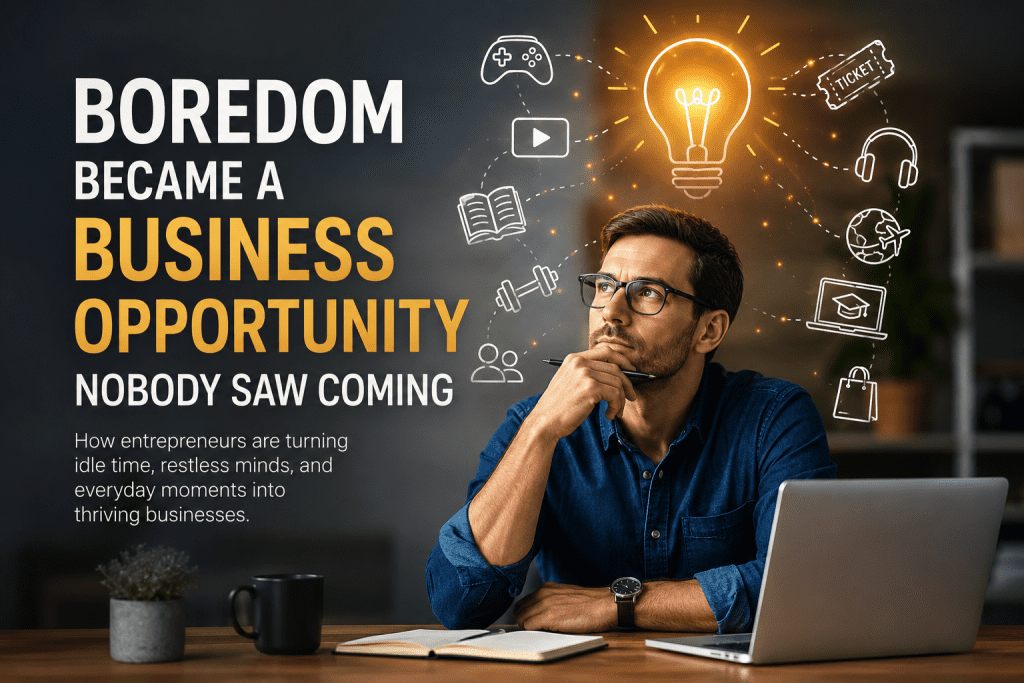
Boredom used to be treated as wasted time. It was the quiet space between work, errands, school, family obligations, and sleep. It was the long wait in a doctor office, the empty Sunday afternoon, the slow commute, the rainy weekend, or the moment when someone sat on the couch and said there was nothing to do. For years, boredom sounded like a personal problem, not a business opportunity. Today, that assumption looks outdated.
A major part of modern business is built around filling empty time. Consumers are not only buying products because they need them. They are buying distractions, activities, subscriptions, memberships, experiences, games, courses, communities, and services that make time feel more useful, more exciting, or more meaningful. Boredom has become one of the quiet drivers behind entire industries. The opportunity was always there, but many business owners did not recognize it because boredom does not announce itself like a traditional market need.
For entrepreneurs, the lesson is powerful. Some of the best business opportunities are not created by obvious pain points. They are created by emotional gaps. People may not say, “I am bored and I need a solution.” Instead, they scroll, subscribe, play, shop, book, join, watch, learn, and look for something that gives them a reason to stay engaged. The businesses that understand that behavior are not merely selling entertainment. They are selling relief from mental stillness, repetition, and routine.
Boredom is more than a lack of activity. In many cases, it reflects a lack of stimulation, novelty, challenge, or connection. People can be surrounded by technology and still feel bored. They can have endless content available and still feel as though nothing holds their attention. That contradiction has become a major business opening.
Consumers now expect more from their free time. They want activities that feel personal. They want entertainment that can be accessed instantly. They want hobbies that can be started without complicated barriers. They want experiences that can be shared online and remembered offline. As a result, businesses that once seemed niche have become mainstream because they give people something to do, something to talk about, and sometimes even something to become part of.
Companies such as Duolingo turned small pockets of idle time into language learning sessions. MasterClass positioned learning as entertainment, giving people a way to turn curiosity into a subscription. Calm and Headspace built businesses around helping people manage the mental space that often appears when life slows down. Each company approaches the issue differently, but they all speak to a similar reality. People are looking for ways to make their time feel better.
That is why boredom matters to business owners. It is not just about fun. It is about attention, behavior, habit, and emotional need. A bored consumer is often a searching consumer. They may be searching for entertainment, but they may also be searching for improvement, connection, relaxation, identity, or a better way to pass the time.
One reason boredom became a business opportunity is that consumers began placing greater value on experiences. Owning more products is not always as appealing as doing something memorable. This shift created room for businesses built around activities rather than possessions.
Companies like Topgolf show how a familiar activity can be redesigned into a social experience. Golf was once intimidating to many casual consumers. Topgolf changed the environment by combining food, music, technology, competition, and group entertainment. The business is not only about hitting golf balls. It is about giving people a place to go when they want something more interesting than dinner but less formal than a major event.
Sandbox VR is another example of boredom meeting technology. Virtual reality has existed for years, but the business opportunity expands when it becomes a shared experience. Instead of one person using a headset at home, groups can book an immersive activity that feels more like a night out. The value is not only in the technology. It is in the novelty, the social element, and the story people can tell afterward.
This is important for entrepreneurs because it shows that boredom does not always require inventing a completely new category. Sometimes the better opportunity is taking something familiar and making it more engaging. Bowling, mini golf, arcades, trivia nights, cooking classes, fitness studios, and escape rooms all benefit from the same underlying pattern. People want something to do, but they also want it packaged in a way that feels worth leaving the house for.
The internet changed boredom forever because it made empty time monetizable. Every spare minute became a possible viewing session, game session, shopping session, message, post, or search. For better or worse, the phone became the default answer to boredom.
Roblox is a strong example of how idle time can become an economy. It is not just a game in the traditional sense. It is a platform where users create, interact, play, and spend. That creates an ongoing cycle of engagement because the experience is constantly changing. For younger users especially, the platform is not simply entertainment. It is also a social environment.
Discord reflects a different side of the same trend. Boredom often leads people toward community. They want to talk, share interests, organize around games, hobbies, investments, creative projects, or business ideas. Discord benefited from the demand for digital spaces where people could gather around very specific interests. The business value is tied to attention, but also to belonging.
For entrepreneurs, the digital lesson is clear. Businesses that can create repeat engagement often have a stronger foundation than those built around a one time sale. A product may solve a problem once. A platform, membership, or community can become part of someone routine. When boredom leads users back repeatedly, retention becomes the real asset.
Not every boredom driven business has to be entertainment focused. Many people use idle time as a prompt for self improvement. They may start a course, learn a skill, listen to a podcast, join a class, or explore a business idea because they feel underused or mentally restless.
This is where education and personal development businesses have found meaningful traction. Platforms such as Coursera and Skillshare serve people who want to convert free time into capability. Some users are career motivated. Others simply want to feel productive. In both cases, boredom becomes the doorway.
This matters even more in a business climate where capital is not as cheap as it was several years ago. When interest rates remain elevated compared with the near zero environment many entrepreneurs remember, business owners become more selective. They may delay hiring, postpone expansion, or avoid unnecessary borrowing. In that type of environment, learning, efficiency, and skill development become more valuable. A business owner who cannot throw money at every problem may invest time instead.
That creates opportunities for companies that help people sharpen skills without requiring a major financial commitment. Affordable courses, coaching groups, business templates, software tutorials, and industry specific training can all benefit from this mindset. The consumer is not just bored. They may be looking for progress at a price they can justify.
Many successful boredom based businesses work because they reduce friction. They make it easy to start. This sounds simple, but it is often the difference between a business that gains traction and one that struggles.
A bored person does not want a complicated onboarding process. They do not want to read a lengthy instruction manual. They do not want to commit to something that feels risky or overly formal. They want a quick path from interest to activity. That is why mobile apps, subscription platforms, pop up experiences, and simple booking tools have become so effective.
Eventbrite gives users a way to discover events without needing to know exactly what they are looking for. Meetup helps people find groups tied to shared interests. Both businesses benefit from the fact that people often want to do something but do not know where to begin. The platform becomes the bridge between boredom and action.
Business owners can apply this thinking in almost any industry. A restaurant can create themed nights. A retailer can host small workshops. A fitness business can offer beginner friendly challenges. A consultant can create short practical webinars. A local service provider can produce useful guides, calculators, or checklists. The goal is not to overwhelm the customer. The goal is to give them an easy next step.
Even with the growth of digital entertainment, physical spaces still matter. In fact, the more time people spend online, the more some consumers crave real world experiences. This has created new opportunities for businesses that combine atmosphere, activity, and social interaction.
Food halls, boutique fitness studios, indoor pickleball clubs, axe throwing venues, immersive art exhibits, escape rooms, and craft workshops all benefit from people wanting something different. They are not always competing with direct competitors. Sometimes they are competing with the customer staying home.
That distinction matters. A business owner may think the competition is another restaurant, gym, or entertainment venue. In reality, the competition may be boredom mixed with convenience. If staying home feels easier, the business has to give people a reason to move. That reason may be social connection, novelty, status, relaxation, or a sense of discovery.
The strongest businesses in this category usually understand that the activity itself is only part of the offer. The environment, lighting, music, staff, booking process, food, photos, and follow up communication all shape the experience. When people are choosing how to spend discretionary income, especially in a higher rate and more cost conscious environment, the experience has to feel worth it.
Traditional market research often focuses on demographics, income, location, and product categories. Those factors still matter, but entrepreneurs should also pay attention to emotional markets. Boredom, loneliness, anxiety, curiosity, ambition, nostalgia, and convenience all influence spending.
Boredom is especially interesting because it can appear across income levels and age groups. A teenager, a retiree, a corporate executive, a parent, and a small business owner can all experience it in different ways. The solution they buy may be different, but the underlying trigger can be similar.
This opens the door for more creative business thinking. A company does not have to ask only, “What does the customer need?” It can also ask, “What is the customer tired of?” They may be tired of the same weekend routine. They may be tired of passive scrolling. They may be tired of feeling unproductive. They may be tired of limited local options. Each answer can point toward a product, service, membership, event, or content strategy.
The businesses that win in emotional markets usually avoid sounding mechanical. They speak to real human behavior. They understand that people do not always make decisions through strict logic. A customer may not need a cooking class, a puzzle subscription, a language app, or a VR experience. But they may still buy it because it makes their time feel richer.
Boredom can support several business models. Subscriptions are one of the most obvious because boredom repeats. A customer who wants fresh content, new lessons, new games, new events, or new activities may be willing to pay monthly if the value remains clear.
Memberships can also work well, especially when community is involved. A fitness club, coworking space, hobby group, or private online community can turn boredom into belonging. The customer is not just paying for access. They are paying for rhythm, identity, and interaction.
One time experiences can be profitable too, particularly when they are premium, shareable, or group oriented. A well designed experience can attract birthdays, corporate outings, date nights, team events, and tourists. The challenge is that one time experiences often need a strong marketing engine because customers must be replaced or reactivated constantly.
Content based businesses have another path. A newsletter, YouTube channel, podcast, blog, or digital publication can capture attention and later monetize through sponsorships, advertising, paid memberships, affiliate relationships, or product sales. In that model, boredom is the entry point, but trust becomes the long term asset.
When money is inexpensive, businesses can sometimes grow through aggressive spending. They can borrow, hire, advertise, lease larger spaces, and test ideas with less pressure. When rates are higher, the decision making changes. Entrepreneurs need to be more disciplined with capital, more thoughtful about customer acquisition, and more focused on business models that can generate revenue without burning through cash.
That does not mean opportunity disappears. It means creativity becomes more valuable. Boredom based businesses can be appealing because many of them begin with insight rather than heavy infrastructure. A strong local event concept, a niche digital community, a practical course, a content platform, or a mobile friendly marketplace may start smaller and prove demand before major expansion.
This is especially important for startups and small business owners. The question is not only whether people are bored. The better question is whether the business can convert boredom into repeatable revenue at a reasonable cost. A clever idea still needs pricing, margins, operations, marketing, customer service, and retention. Boredom may open the door, but execution determines whether the opportunity becomes a real company.
Boredom became a business opportunity because people are constantly looking for better ways to use their time. They want to be entertained, challenged, connected, relaxed, informed, and inspired. That search has created room for companies in education, entertainment, wellness, events, digital platforms, local experiences, and community building. For entrepreneurs, the bigger lesson is that not every opportunity begins with an obvious problem. Sometimes the opening is hidden in a feeling people barely mention. When a business can recognize that feeling and turn it into something useful, enjoyable, or memorable, boredom stops being wasted time and becomes a market worth paying attention to.