
Commercial landscaping was once viewed primarily as a maintenance service. Property owners hired contractors to mow lawns, trim hedges, remove weeds, and keep outdoor areas presentable. Although those responsibilities remain…
Read More...





Economic cycles are part of business life, but that does not make them easy to manage. A growing company can feel strong during an expansion, only to find out later that its financial foundation was not as solid as it appeared. Revenue may have been rising, customers may have been active, and new opportunities may have seemed available, but when borrowing costs climb, consumer demand weakens, and buyers become cautious, the pressure can show up quickly.
The word recession often creates an immediate reaction. Some business owners think of layoffs, falling sales, tighter credit, delayed payments, or reduced customer spending. Others view a slowdown as a chance to strengthen operations, improve discipline, and gain market share while less prepared competitors struggle. The difference usually comes down to planning. A business does not need to predict the exact timing of the next recession to prepare for one. It needs to build enough flexibility to survive a difficult period and enough clarity to make smart decisions before conditions force rushed choices.
Interest rates are an important part of that conversation. When rates are higher, debt becomes more expensive, refinancing becomes more difficult, and customers who rely on financing may pull back. Even companies without significant debt can feel the effect through suppliers, landlords, vendors, and customers. Higher rates can slow real estate activity, reduce capital spending, and make investors more selective. For entrepreneurs and business owners, recession planning is no longer only about cutting expenses. It is about understanding how the entire financial environment affects sales, margins, cash flow, and growth.
Many owners look at recession preparation as a cost cutting exercise. While expenses matter, a downturn tests much more than the expense side of the income statement. It reveals whether the company has a durable value proposition, dependable customers, pricing power, reliable systems, and management discipline.
A business that sells something customers truly need will usually have more resilience than one dependent on impulse purchases or discretionary spending. That does not mean every essential business is safe, or every discretionary business is vulnerable. It means leadership needs to understand why customers buy, how often they buy, how easily they can delay the purchase, and whether a competitor can undercut the offer when money gets tight.
Consider companies that serve other businesses with mission critical products. Grainger supplies maintenance, repair, and operating products that many businesses still need even when budgets tighten. A company like Toast serves restaurants with technology tied to daily operations. Those types of businesses still face economic risk, but their services are connected to ongoing operational needs. By contrast, businesses that depend heavily on nonessential upgrades, luxury purchases, or speculative expansion may face faster pullbacks when the economy weakens.
For smaller companies, the same principle applies. A marketing agency, local contractor, consulting firm, restaurant supplier, or software provider should know which part of its revenue is essential, which part is optional, and which part may disappear first in a downturn. That analysis helps owners avoid treating all revenue the same.
Profit matters, but cash flow keeps the business alive. A company can show accounting profit and still struggle if customers pay late, inventory sits too long, or debt payments consume available cash. During a recession, these problems often become more severe because everyone in the chain is trying to preserve liquidity.
Business owners should review accounts receivable before trouble begins. Which customers pay slowly? Which accounts represent concentration risk? Which contracts have vague payment terms? Which customers would create a serious problem if they delayed payment by 30, 60, or 90 days? These questions are not theoretical. In a slowdown, customers that once paid reliably may stretch terms to manage their own cash flow.
Inventory also deserves attention. Too much inventory ties up cash. Too little inventory can hurt sales if supply chains become strained. The right balance depends on the business, but the owner should know which products move quickly, which products sit too long, and which items should not be reordered without a clear sales reason. A restaurant equipment company, a fashion retailer, an automotive parts supplier, and an e commerce seller may all face different inventory risks, but each one needs discipline.
A healthy cash reserve can provide breathing room, but it should not create complacency. Cash can disappear quickly when revenue drops and fixed costs remain. Rent, payroll, insurance, software subscriptions, loan payments, utilities, and professional fees do not automatically shrink when sales slow down. The goal is to understand how many months the business can operate under several revenue scenarios, not just under normal conditions.
Interest rates influence more than bank loans. They affect consumer confidence, investment decisions, credit card balances, home equity borrowing, commercial real estate activity, and the cost of capital for growth. A business that planned expansion around cheap money may need a very different strategy when financing costs rise.
Higher rates can make debt service more burdensome. A company with variable rate debt may see payments increase even if revenue stays flat. A business looking to refinance may discover that the new terms are less favorable than expected. A startup seeking capital may face more demanding investors because safer fixed income alternatives look more attractive than they did in a low rate environment.
This is why companies should review debt structure before they are under pressure. Owners should know maturity dates, interest rates, covenants, collateral obligations, personal guarantees, and refinancing options. They should also understand whether any vendor financing, equipment financing, merchant cash advances, or credit lines could become a problem if revenue declines.
A company like Caterpillar operates in industries where financing, construction activity, energy investment, and infrastructure spending can play a major role in demand. Smaller businesses can learn from that broader reality. When customers rely on financing to buy equipment, vehicles, property, or large projects, interest rates can influence the timing of those purchases. If your business depends on customers making financed purchases, recession planning should include a close look at how higher borrowing costs may affect demand.
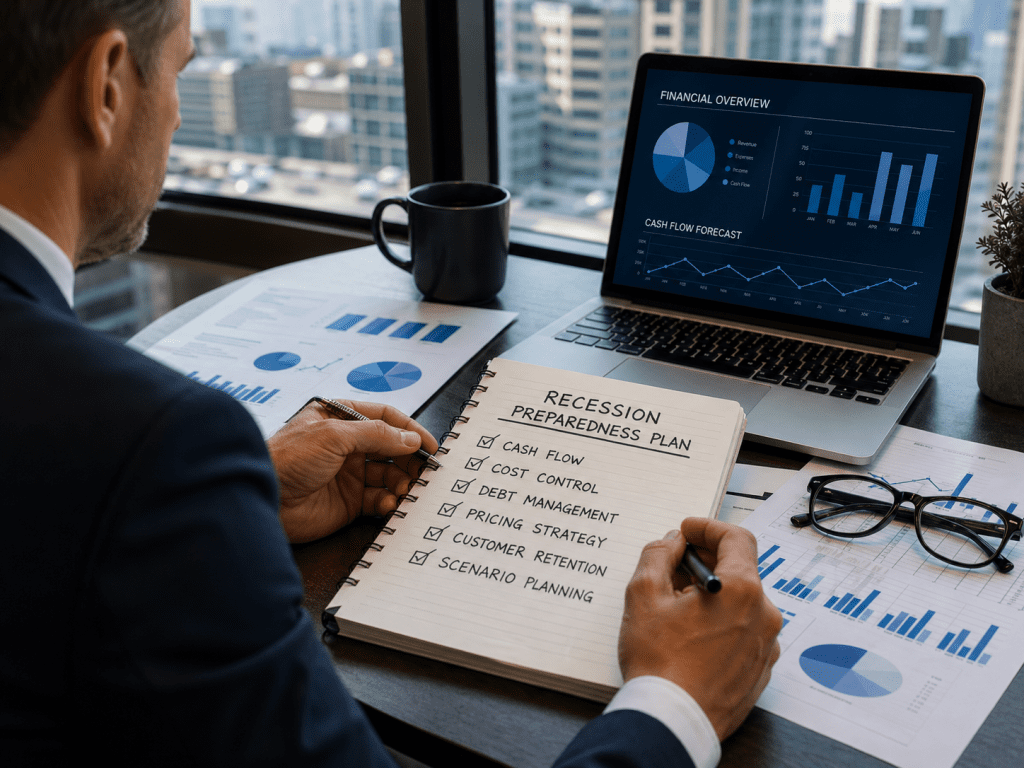
In a strong economy, businesses can sometimes raise prices without much resistance. During a recession, customers scrutinize every expense. They ask for discounts, compare competitors, delay decisions, or reduce order size. That does not mean the right answer is always to cut prices. In many cases, cutting prices can damage margins without creating enough additional volume to make up the difference.
The better question is whether the business has pricing power. Pricing power comes from trust, quality, convenience, specialization, brand reputation, scarcity, service, or measurable results. If customers view your product as interchangeable, they will usually shop harder when budgets tighten. If they see your company as reliable, responsive, and valuable, price pressure may still appear, but it may be easier to defend your margins.
Costco is a useful business example because its value proposition is clear. Customers understand the membership model, the pricing philosophy, and the savings appeal. During uncertain economic times, that clarity can be powerful. A small business does not need Costco’s scale to apply the lesson. It needs a clear reason customers continue buying when money becomes tighter.
Owners should review their offers before a downturn. Are there services that can be packaged differently? Are there lower cost entry options that protect the customer relationship without destroying margins? Are there premium services that still appeal to customers who value speed, quality, or convenience? A recession may require more flexible offers, but flexibility should be planned, not improvised.
Revenue concentration often feels good when the large customer is paying on time. It becomes dangerous when that customer slows purchasing, renegotiates terms, delays payment, or leaves. A business with one customer representing 35 percent of revenue may look stable until that relationship changes.
Recession planning should include a concentration review. Owners should know how much revenue comes from the top five customers, top ten customers, and most profitable accounts. They should also look at industry concentration. A company may have many customers but still be exposed if most of them operate in the same vulnerable sector.
This matters for service businesses, manufacturers, distributors, software providers, and professional firms. A consultant serving mostly real estate developers may feel pressure if development slows. A supplier serving mostly restaurants may be affected if dining traffic weakens. A vendor serving venture backed startups may face cuts if funding becomes harder to secure.
The goal is not to abandon good customers. It is to avoid being overly dependent on any single relationship, industry, or channel. Diversification does not have to mean chasing every possible market. It can mean carefully adding customer segments that respond differently to economic pressure.
A recession can expose weak operations, but it can also create a chance to improve. When growth is fast, businesses often tolerate messy processes because sales cover the inefficiency. When sales slow, the cost of disorganization becomes more obvious.
Owners should look at workflow, staffing, technology, vendor relationships, and customer service. Are employees spending too much time on manual tasks? Are there software tools that can reduce administrative burden? Are managers tracking the right numbers? Are customer complaints pointing to a recurring operational issue?
Companies like Intuit and Shopify serve business owners by helping them manage financial, operational, and commerce related functions. The broader point is that technology should support better decisions, not just add another monthly subscription. Before a downturn, owners should review which tools actually improve productivity and which ones are underused.
Operational improvement also includes vendor negotiation. A business may be able to renegotiate payment terms, consolidate suppliers, reduce waste, or improve purchasing discipline. These changes should be handled professionally. Vendors are part of the business ecosystem, and aggressive pressure can damage relationships. Still, a recession ready company does not wait until cash is tight to understand its cost structure.
One common mistake during a slowdown is cutting marketing too deeply. Marketing expenses should be reviewed, but disappearing from the market can make recovery harder. When customers are cautious, they often need more trust, more education, and more reminders of value.
The better approach is to shift marketing toward measurable activity. Which channels bring qualified leads? Which campaigns produce customers with strong lifetime value? Which messages connect with current economic concerns? Which content helps buyers make a confident decision?
A business may reduce experimental spending while protecting proven channels. It may focus more on retention, referrals, email marketing, search visibility, and customer education. A company may also use a downturn to strengthen brand positioning while competitors go quiet.
For entrepreneurs and startups, this is especially important. A recession does not eliminate opportunity. It changes what customers care about. They may become more interested in savings, productivity, risk reduction, durability, and practical value. Marketing should reflect that shift. The message should meet the market where it is, not where it was during easier conditions.
Payroll is often one of the largest expenses in a business. During a recession, owners may need to make difficult staffing decisions. However, cutting too quickly can harm service, morale, and future growth. Keeping the wrong structure for too long can also threaten the entire company.
The best time to review staffing is before the business is in crisis. Which roles are essential to revenue, service, compliance, or operations? Which positions are tied to projects that may be delayed? Are there employees who can be cross trained? Are managers clear on performance expectations?
A business may find alternatives before layoffs become necessary. Reduced overtime, hiring pauses, role adjustments, contractor review, or voluntary schedule changes may help. In other cases, a company may need to make more serious decisions. Those decisions should be handled with professionalism and respect.
Companies that maintain trust with employees are often better positioned when conditions improve. People remember how leadership communicates during difficult periods. Silence, confusion, and sudden decisions can create fear. Clear communication does not remove every concern, but it helps employees understand the company’s direction.
No business owner knows exactly when the next recession will happen, how deep it will be, or how long it will last. That uncertainty can become paralyzing unless it is converted into scenario planning.
A practical approach is to model several revenue declines. What happens if revenue falls 10 percent? What if it falls 20 percent? What if the decline lasts six months? What if customers pay more slowly at the same time? What if a major customer leaves? What if borrowing costs rise further or a credit line is reduced?
These scenarios do not need to be perfect. They need to be useful. The purpose is to identify decision points before pressure builds. At what revenue level would hiring pause? At what point would the company reduce discretionary spending? Which expenses would be cut first? Which investments would continue because they support long term strength?
Scenario planning also helps owners see where action is needed now. If the business cannot withstand even a modest revenue decline, the owner may need to build reserves, reduce fixed costs, improve collections, or adjust pricing. If the business is stronger than expected, the owner may be able to plan opportunistic moves such as acquiring assets, hiring talent, or expanding into a market where competitors are retreating.
A recession is not only a threat. It can be a dividing line between businesses that operate reactively and businesses that operate with discipline. Prepared companies may be able to negotiate better leases, acquire customers from weaker competitors, purchase equipment at better prices, hire talented people, or enter new markets with less noise.
That does not mean owners should become reckless. Opportunity during a downturn still requires caution. Cash matters. Timing matters. Execution matters. But a business that has prepared can make decisions from a position of strength instead of fear.
Look at a company like Delta Air Lines. Airlines operate in a highly cyclical industry affected by fuel costs, consumer demand, business travel, labor, financing, and global events. While small businesses are very different, the lesson is useful. Cyclical pressure requires planning, flexibility, and constant attention to operating metrics. Businesses that ignore economic cycles are more likely to be surprised by them.
Entrepreneurs should also remember that many strong companies were built or strengthened during difficult periods. A downturn can force sharper thinking. It can push owners to focus on profitable customers, practical innovation, and financial discipline. The challenge is to do that work before survival depends on it.
Recession preparation is not about predicting disaster. It is about building a business that can handle pressure without losing direction. Owners should review cash flow, debt, pricing, customer concentration, staffing, marketing, and operations while they still have room to make thoughtful choices. Interest rates, inflation, and tighter credit conditions can all change the way customers buy and the way companies finance growth. A business that waits until revenue falls may have fewer options and less negotiating power. A business that prepares early can protect its foundation, make calmer decisions, and potentially find opportunities that others miss. For entrepreneurs, business owners, and anyone thinking about starting a company, recession readiness should be part of the business plan, not an emergency project saved for later.